Record Entry No. 3
U.S. Adaptive Open, Evian Championship, Major Saturation, and a Eulogy for Firestone
U.S. Adaptive Open
It has always been The Society's position that Golf asks only two things of those who play it:
I. Produce a score.
II. Honor The Orders.
The U.S. Adaptive Open continues to demonstrate that Golf remains one of the few sports capable of accommodating competitors with vastly different circumstances while preserving the integrity of competition. Adaptations can exist where necessary, but the essence of the game remains unchanged. Every competitor is still confronted with the same timeless questions of judgment, execution, and composure.
The Society is pleased to report that no notable violations of The Orders came to its attention throughout the championship. Every competitor is to be commended for their talent, grit, and for reminding us that adherence to Order II is not dependent on circumstance.
Championship Inflation
The women's professional game is healthier today than at perhaps any point in its history: Prize purses continue to grow. Fields continue to strengthen. These are developments which The Society views with great favor.
Money, however, has never been responsible for determining the importance of a championship.
Major championships derive their significance from history, competitive identity, and the collective agreement that they occupy a place above all others. Those qualities cannot simply be purchased.
The PGA TOUR has spent decades discovering this lesson through The Players Championship. It remains one of the finest tournaments in professional golf, yet the distinction between "flagship event" and "major championship" persists despite every effort to blur it.
The Evian Championship finds itself confronting a similar reality. Yes, the purse is worthy. Of course, the field is worthy. The setting at the Evian Resort Club in the French Alps is certainly nothing short of spectacular. However, whether the golf course itself possesses the architectural character expected of a major championship remains a more complicated question. Past critiques of the course from the players themselves have laid these questions bare.
The Society’s stance is that championship status is far easier to preserve than it is to create. When its creation is forced rather than revealed, the question of legitimacy has a habit of lingering.
Major Schedule Competition
Each year July arrives and presents golf fans with continued scheduling curiosities, with this week providing one of the greatest head scratchers of the year.
As the Evian Championship tees off in France, another men's major, the Senior Players Championship, will be contested concurrently at Firestone Country Club in Ohio. Further, the PGA TOUR will stage one of its premier events of the season at the Genesis Scottish Open.
There is no doubt that scheduling conflicts are inevitable as each tour grapples with international travel, player logistics, and the brief window of favorable summer weather. Even so, this level of competition for viewers is a major championship in and of itself. Golf has too many tours asking for our undivided attention at the same time.
Major championships are intended to command attention. The Society remains unconvinced that staging senior majors in consecutive weeks best serves either event or the senior circuit in general. It is equally unconvinced that these tours cannot work together to preserve dedicated space on the calendar for their most important championships. Divided attention is no way to showcase the game's finest competitors. The unavoidable conclusion is that one—or perhaps several—of these organizations has decided it is better to compete for viewers than to elevate one another.
A Eulogy for Firestone
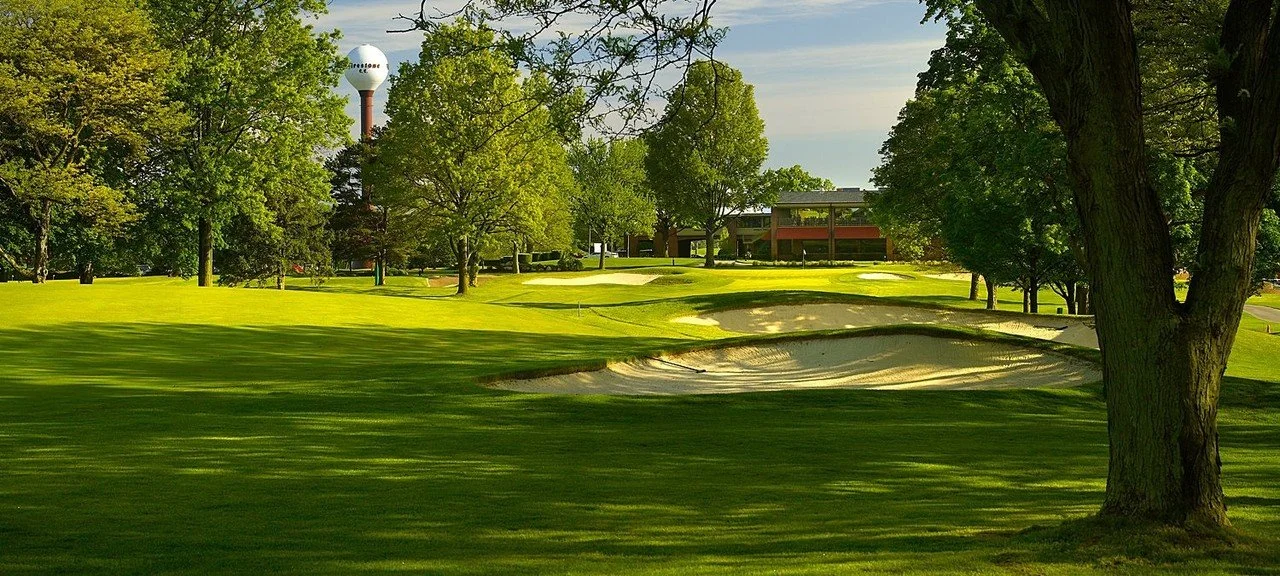
There was a time when arriving at Firestone Country Club meant arriving at one of championship golf's most imposing examinations. It’s a course of enormous scale designed by Robert Trent Jones, Sr.; long, narrow, and demanding, Firestone rewards powerful and accurate driving, towering long irons, and an unwavering willingness to accept Jones’ design mantra of “hard par, easy bogey.”
No player embodied those qualities more completely than Tiger Woods, who, over sixteen appearances in the World Golf Championships at Firestone, won eight times. Firestone defined an era of golf history. Three PGA Championships. Sixteen World Golf Championships. Countless summer afternoons where the game's best arrived knowing precisely what awaited them. And yet golf architecture, like golf itself, evolves.
The modern championship has gradually shifted away from tree-lined corridors demanding power and accuracy above all else. Today's architectural conversation favors width over confinement, angles over repetition, and strategic options over singular solutions. The great courses of the early twentieth century have become the model once more, asking competitors not merely to execute shots, but to plot them wisely.
Firestone did not become a lesser golf course. The game simply went back to asking older questions. We must accept that not every championship venue is meant to endure forever. Some define their generation before quietly yielding to the next.
Firestone's contribution to championship golf history is secure, especially considering its list of legendary winners. The greatest players of their time walked its fairways with distinction. The Society does not mourn. It simply records its appreciation.